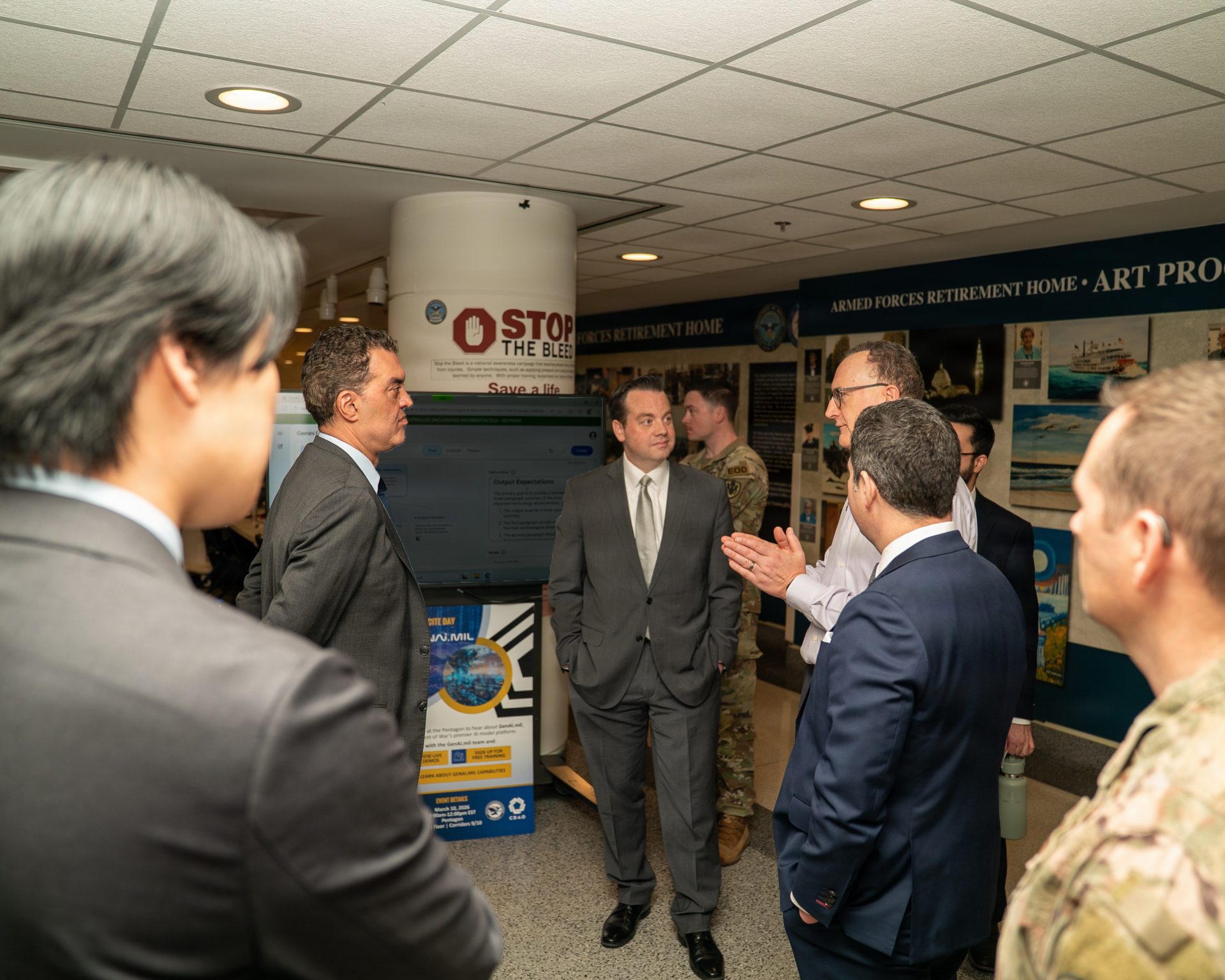
On May 1, 2026, the Pentagon expanded its classified-network AI program to eight vendors. SpaceX, OpenAI, Google, Nvidia, Reflection, Microsoft, AWS, and — added hours later — Oracle. The contracts cover deployment on Impact Level 6 and Impact Level 7 networks, the most restrictive secure environments in the Department of Defense, used for top-secret and critical-national-security workloads. Pentagon CTO Emil Michael described the strategy plainly: "We went out and made sure that we had multiple different providers — both open source, which is a new effort here at the department, and the proprietary model companies." The Pentagon's own statement called the contracts a step toward "establishing the United States military as an AI-first fighting force."
The story is not the eight names on the list. The story is the one name that's missing.
Anthropic — the second-largest frontier AI lab in the world by revenue, and the only one whose CEO has publicly defined "red lines" — was explicitly left out. The exclusion is not new. In late February, Pentagon Secretary Pete Hegseth and Pentagon CTO Emil Michael delivered Anthropic a contractual ultimatum: accept "all lawful purposes" language, or be removed from the federal procurement track entirely. Anthropic refused on two specific grounds. No autonomous-weapons targeting decisions. No domestic mass surveillance. CEO Dario Amodei stated the position publicly on April 30: "Frontier AI systems are simply not reliable enough to power fully autonomous weapons, and the company will not knowingly provide a product that puts America's warfighters and civilians at risk." Anthropic offered to work directly with DoD on R&D to improve reliability instead. The Pentagon declined.
What followed was the most aggressive procurement retaliation any AI company has experienced in this cycle. DoD designated Anthropic a "supply chain risk" — a label typically applied to foreign adversaries, not to a US company headquartered in San Francisco with a board including former White House officials. Anthropic sued in two federal courts on March 9, alleging First Amendment retaliation and Administrative Procedure Act violations. On March 26, US District Judge Rita Lin granted a preliminary injunction, finding the designation was likely "pretextual" and that the government's "real motive was unlawful retaliation" for Anthropic's public stance on AI safety. On April 9, an appeals court limited the injunction's scope. On April 17, Trump met Amodei at the White House and afterward told CNBC a deal was "possible." On April 29, Axios reported the administration was drafting an executive order to reopen the federal door. Two days later, the Pentagon announced eight contracts and Anthropic was not on the list.
The numbers underneath this case are unusually clean. Anthropic just demonstrated, in lost revenue, the cost of holding a use-case red line under maximum pressure from a sitting administration. Every other major frontier lab demonstrated, in signed contracts, that they would accept "all lawful purposes" language — which by the Pentagon's own contractual interpretation includes autonomous-weapons targeting and domestic mass surveillance. That language is now in the procurement record of OpenAI, Google, Nvidia, Microsoft, AWS, Oracle, SpaceX, and Reflection. It will appear in every subsequent enterprise sales conversation those companies have with regulated buyers.
The countervailing angle is the part nobody is saying out loud. For an enterprise buyer in a compliance-heavy industry — a European bank, a US hospital system, a regulated insurer, a government in a country with a constitutional bar on mass surveillance — Anthropic just produced the most credible vendor-trust signal in the history of the AI procurement market. They didn't write a blog post about safety. They didn't issue a press release. They paid for it in revenue, in front of a hostile administration, with a federal court ruling on the record validating that the ban was retaliation for the position itself. That is not a marketing claim. That is enforceable, observable, priced behavior. Every competitor that signed on May 1 just made it harder to make a similar claim about themselves.
The other line that should worry every other major AI lab is Reflection's inclusion. Reflection AI is an Nvidia-backed startup with a focus on open-source models. It was selected to deploy in IL6 and IL7 environments alongside Microsoft, AWS, and OpenAI. The Pentagon's stated goal is to "build an architecture that prevents AI vendor lock-in." If a small open-source-leaning startup can land a classified-network deal, two things follow. First, the moat between frontier labs and the next tier shrunk overnight. Second, the Pentagon is signaling it does not need any one of the giants — and is therefore in a stronger position to demand contractual concessions from each of them.
Three things to watch over the next 60-90 days. First, whether the Trump administration follows through on the reported executive order to reopen federal procurement to Anthropic — and whether Anthropic accepts on terms it spent the spring fighting for. Second, whether any of Anthropic's enterprise customers in regulated industries publicly cite the Pentagon exclusion as a reason for choosing Claude. Third, whether the appeals-court rebuff on April 9 produces any new procurement carve-outs that quietly make their way into other labs' federal contracts.
The takeaway is simple, and it is not the one most coverage is reaching for. Anthropic did not lose. Anthropic priced principle. For the rest of the AI market, the question Anthropic just answered out loud is the one every commercial customer has wanted answered for two years: when this lab says "we won't do that," does it actually mean it? In Anthropic's case, now, demonstrably, yes — at the cost of a multi-year Pentagon revenue stream. Every other lab still owes that question an answer.
Sources
- 1.DefenseScoop — DOD expands its classified AI work with 8 companies — excluding Anthropic — amid ongoing dispute · May 1, 2026
- 2.CNN Business — Pentagon strikes deals with 7 Big Tech companies after shunning Anthropic · May 1, 2026
- 3.TechCrunch — Pentagon inks deals with Nvidia, Microsoft, and AWS to deploy AI on classified networks · May 1, 2026
- 4.Breaking Defense — Pentagon clears 8 tech firms to deploy their AI on its classified networks · May 1, 2026
- 5.Defense News — Pentagon freezes out Anthropic as it signs deals with AI rivals · May 1, 2026
- 6.The Hill — Seven AI firms agree to deploy tech in Pentagon classified networks · May 1, 2026
- 7.NPR — Anthropic sues the Trump administration over 'supply chain risk' label · Mar 9, 2026
- 8.Fortune — The Pentagon brands Anthropic CEO Dario Amodei a 'liar' with a 'God complex' as deadline looms · Feb 27, 2026
- 9.CBS News — Anthropic CEO says he's sticking to AI 'red lines' despite clash with Pentagon · Feb 26, 2026
- 10.CNBC — Anthropic CEO Amodei says Pentagon's threats 'do not change our position' on AI · Feb 26, 2026
- 11.Axios — Trump officials draft plan to bring Anthropic back amid Pentagon fight · Apr 29, 2026
- 12.Anthropic — Statement from Dario Amodei on our discussions with the Department of War · Apr 30, 2026
- 13.Military.com — Appeals Court Rebuffs Anthropic in Latest Round of Its AI Battle with the Trump Administration · Apr 9, 2026
- 14.Fortune — Big Tech is about to spend $700 billion on AI this year. No one knows where the buildout ends · Apr 30, 2026